

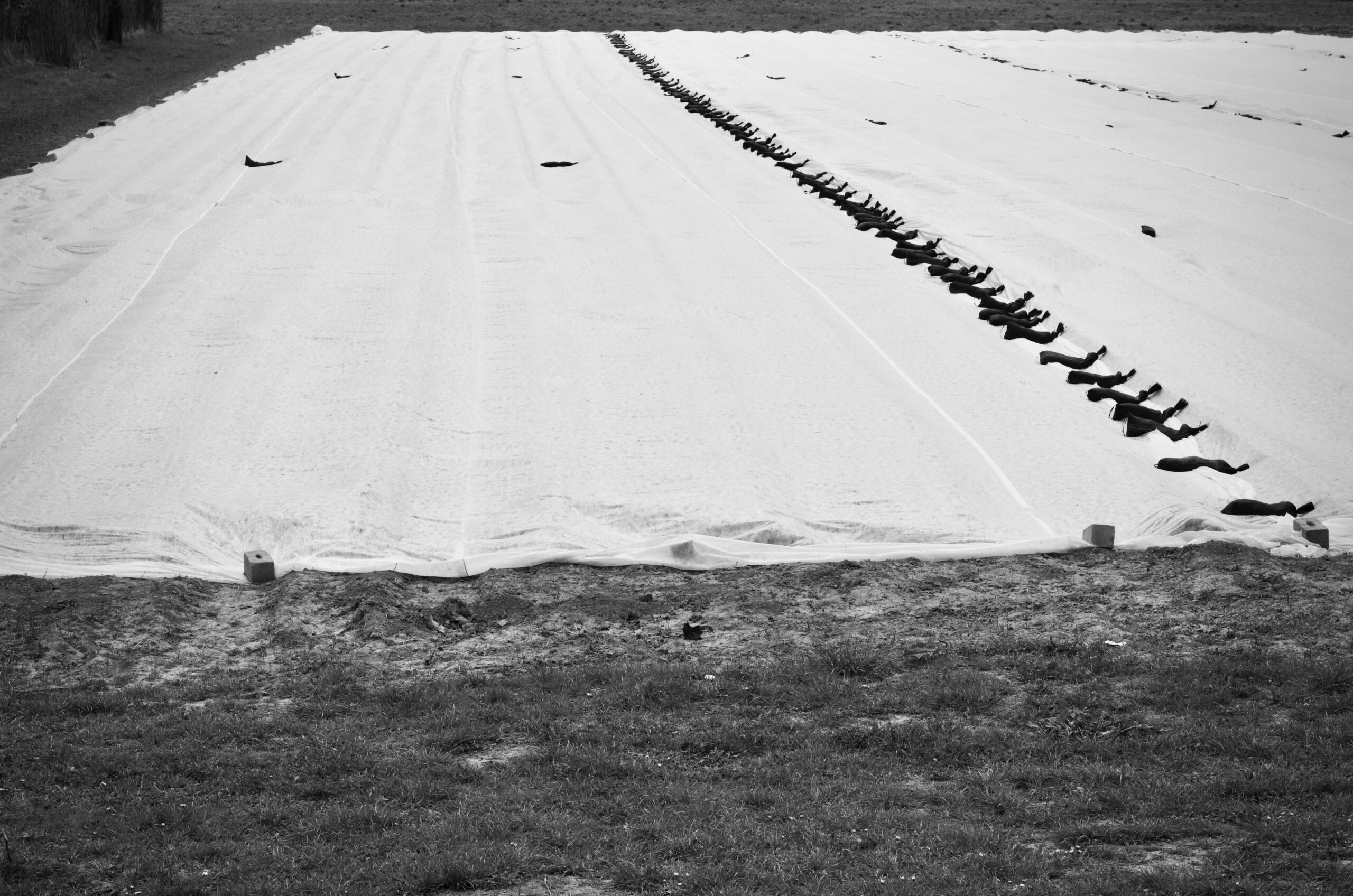

Geotextiles are permeable textile fabrics specifically manufactured for geotechnical and civil engineering applications. They are placed in contact with soil or other earth materials to perform functions such as separation, reinforcement, filtration, drainage, and protection.
Unlike conventional fabrics that prioritize comfort, aesthetics, or appearance, geotextiles are engineered for performance under harsh environmental conditions. They are expected to maintain their structural integrity while being subjected to continuous mechanical stress, moisture, microbial activity, chemical exposure, and temperature fluctuations.
The majority of geotextiles are produced from synthetic polymers due to their excellent resistance to degradation. Polypropylene remains the most commonly used material because of its low density, high chemical resistance, and economic advantages. Polyester is also widely used because of its superior tensile strength and dimensional stability. In certain specialized applications, polyethylene and polyamide fibers may be utilized to achieve specific performance requirements.
The selection of raw materials is a critical stage in geotextile manufacturing because fiber properties directly influence long-term durability, mechanical strength, permeability, and resistance to environmental factors.
What makes geotextiles particularly interesting from a textile engineering perspective is that their performance depends heavily on textile parameters such as fiber type, yarn construction, fabric architecture, manufacturing technology, porosity, permeability, tensile strength, and durability. As a result, the successful design of geotextiles requires a combination of textile science, polymer engineering, and geotechnical knowledge.
Evolution of Geotextiles
The use of fibrous materials for soil stabilization dates back thousands of years. Ancient civilizations often reinforced roads and embankments using natural materials such as straw, reeds, bamboo, and woven plant fibers. While these materials provided temporary reinforcement, their limited durability restricted their effectiveness.
The emergence of synthetic fibers during the twentieth century transformed the possibilities for geotechnical reinforcement. The development of polypropylene and polyester fibers provided engineers with materials that combined high strength, low weight, chemical resistance, and long service life.
During the 1960s and 1970s, advances in textile manufacturing technology allowed the production of fabrics specifically engineered for geotechnical applications. The rapid growth of nonwoven technology further accelerated the adoption of geotextiles by providing highly permeable materials suitable for filtration and drainage.
Today, geotextiles represent a highly specialized segment of technical textiles, supported by advanced manufacturing processes, sophisticated testing standards, and continuous research into new fiber technologies.
Classification of Geotextiles
Woven Geotextiles
Woven geotextiles are produced through conventional weaving processes in which warp and weft yarns are interlaced in a predetermined pattern. The weaving process creates fabrics with excellent tensile strength and dimensional stability.
From a textile engineering perspective, woven geotextiles require careful yarn selection and fabric design. High-tenacity multifilament or monofilament yarns are commonly employed to achieve the required mechanical properties. Fabric construction parameters such as yarn density, weave pattern, and cover factor significantly influence strength, elongation, and filtration characteristics.
Because of their high load-bearing capacity, woven geotextiles are widely used in road stabilization, embankment reinforcement, and retaining wall construction.
Nonwoven Geotextiles
Nonwoven geotextiles are manufactured directly from fibers without converting them into yarns. These materials are typically produced through needle-punching, thermal bonding, or chemical bonding processes.
The absence of an organized yarn structure allows nonwoven geotextiles to possess higher permeability and improved filtration characteristics. Their random fiber arrangement creates interconnected pore structures that facilitate water movement while retaining soil particles.
Needle-punched nonwovens are particularly popular because they provide a balance between mechanical strength and hydraulic performance. The density of needle penetration, fiber fineness, and web weight all influence the final properties of the fabric.
Knitted Geotextiles
Knitted geotextiles are produced through loop formation processes similar to those used in apparel textiles. Although their use is relatively limited, knitted structures provide high flexibility and extensibility.
These fabrics can be combined with woven or nonwoven structures to create composite geotextiles with enhanced performance characteristics. Such hybrid constructions are increasingly being explored for specialized engineering applications.
Textile Manufacturing Technologies Behind Geotextiles
The manufacturing of geotextiles involves a series of carefully controlled processes that determine the final performance of the material.
Yarn Engineering
In woven geotextiles, yarn properties significantly influence fabric behavior. High-tenacity yarns are engineered to withstand heavy loads while maintaining dimensional stability over long service periods.
Textile engineers must optimize factors such as yarn twist, filament arrangement, linear density, and yarn uniformity to achieve the desired balance of strength and permeability.
Weaving Technology
Modern weaving systems allow the production of geotextiles with highly controlled structural properties. Plain weave, twill weave, and leno weave constructions may be employed depending on the intended application.
Leno weaving is particularly important in geotextile manufacturing because it creates stable openings that enhance filtration performance while maintaining structural integrity.
Advanced weaving technologies also enable the production of wide-width fabrics, reducing installation time and minimizing seam-related weaknesses.
Needle-Punching Technology
Needle-punching is one of the most widely used methods for manufacturing nonwoven geotextiles. During this process, thousands of barbed needles repeatedly penetrate the fiber web, mechanically entangling the fibers and creating a coherent fabric structure.
The number of needle penetrations, penetration depth, and needle geometry directly influence fabric thickness, strength, porosity, and permeability.
This process allows manufacturers to produce highly durable fabrics capable of performing effectively under challenging environmental conditions.
Thermal Bonding
Thermal bonding involves the application of heat to fuse thermoplastic fibers at their contact points. The process enhances dimensional stability and improves mechanical properties without significantly reducing permeability.
The careful control of bonding temperature and pressure is essential to achieving the desired balance between strength and hydraulic performance.
Key Functions of Geotextiles
The effectiveness of geotextiles arises from their ability to perform multiple engineering functions simultaneously.
The separation function prevents different soil layers from mixing, thereby maintaining the integrity of pavement structures. Filtration allows water to pass while retaining soil particles, preventing erosion and maintaining drainage efficiency. Drainage facilitates the controlled movement of water through soil systems, reducing hydrostatic pressure.
Reinforcement enhances the load-bearing capacity of weak soils by distributing stresses over a larger area. Protection safeguards geomembranes and other geosynthetic materials from mechanical damage. Erosion control stabilizes soil surfaces and prevents material loss caused by water flow or environmental exposure.
The successful performance of these functions depends heavily on textile parameters such as pore size distribution, fabric thickness, tensile strength, and permeability.
Applications in Modern Infrastructure
Geotextiles have become indispensable in modern infrastructure projects. They are extensively used in road and highway construction to improve pavement performance and reduce maintenance requirements. Railway systems utilize geotextiles to stabilize ballast layers and improve drainage.
In airport construction, geotextiles help distribute heavy aircraft loads and minimize settlement. Landfill engineering relies on geotextiles for filtration, drainage, and environmental protection. Coastal engineering projects employ geotextiles to prevent erosion and stabilize shorelines, while dams and reservoirs benefit from their drainage and reinforcement capabilities.
These applications demonstrate the remarkable versatility of textile materials when engineered for technical purposes.
Sustainability and Environmental Benefits
The growing emphasis on sustainable construction has further increased interest in geotextile technology. By extending the lifespan of infrastructure and reducing the need for maintenance and replacement, geotextiles contribute significantly to resource conservation.
Textile researchers are increasingly investigating biodegradable alternatives manufactured from natural fibers such as jute, coir, hemp, and flax. These materials offer environmentally friendly solutions for temporary applications such as erosion control and vegetation establishment.
In addition, recycled polymer technologies are enabling manufacturers to produce geotextiles from post-consumer and industrial plastic waste, reducing environmental impact while maintaining performance standards.
Future Trends in Geotextile Engineering
The future of geotextiles lies at the intersection of textile innovation and smart infrastructure.
Smart geotextiles equipped with embedded sensors are being developed to monitor stress, strain, moisture content, and temperature within engineering structures. Such systems can provide real-time information about infrastructure health and help prevent structural failures.
Nanotechnology is also opening new possibilities for enhancing geotextile performance. Nanofiber coatings and nano-engineered polymers can improve durability, mechanical strength, and resistance to environmental degradation.
Advanced composite geotextiles combining woven, nonwoven, and functional layers are being developed to perform multiple functions simultaneously. These next-generation materials demonstrate how textile engineering continues to drive innovation in civil engineering applications.
Conclusion
Geotextiles are among the most successful examples of technical textiles transforming traditional industries. While their applications are rooted in civil engineering, their performance is fundamentally dependent on textile engineering principles. Fiber selection, yarn design, fabric construction, manufacturing technology, and material testing all play crucial roles in determining the effectiveness of geotextile systems.
As infrastructure demands continue to grow and sustainability becomes increasingly important, geotextiles will remain at the forefront of technical textile innovation. For textile engineers, they represent a unique opportunity to apply advanced material science and manufacturing expertise to solve some of the world’s most pressing infrastructure challenges. Beneath every stable road, resilient railway, and protected shoreline lies a powerful reminder that modern engineering is often supported by sophisticated textile technologies working quietly beneath the surface.