

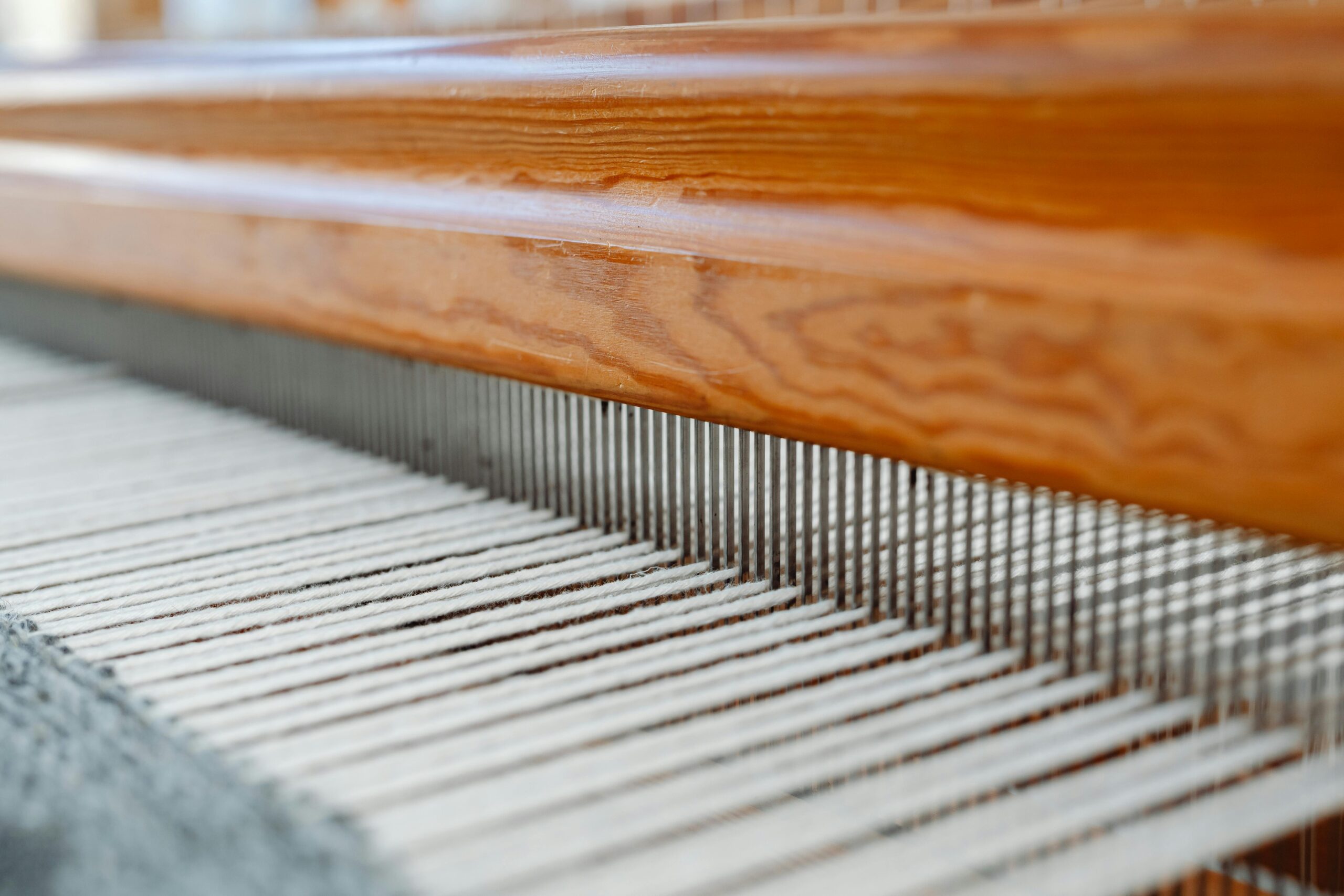

Fabric defect detection has always been one of the most important quality control steps in textile manufacturing. Even small flaws such as broken yarns, stains, holes, or weaving irregularities can significantly reduce fabric value, increase rejection rates, and impact export competitiveness. Traditionally, this process has depended on human inspectors who visually examine moving fabric rolls. While this method has worked for decades, it is increasingly becoming insufficient in modern high-speed production environments due to fatigue, inconsistency, and subjective judgment.
In recent years, artificial intelligence (AI), particularly computer vision and deep learning, has started transforming how defects are detected, classified, and managed in textile production.
Problems With The Traditional Method: Manual Fabric Inspection
In conventional textile mills, fabric inspection is carried out using inspection machines or light tables where operators visually monitor fast-moving fabric surfaces. This process is highly dependent on human attention and skill, which naturally declines over long shifts. As a result, defect detection accuracy is inconsistent, and small or subtle defects are often missed. Another limitation is that inspectors may disagree on whether a defect is critical or acceptable, leading to subjective quality decisions. As production speeds continue to increase in modern weaving and knitting machines, manual inspection struggles to keep up with the required precision and consistency.
Why AI Became a Game Changer
AI-based defect detection systems address these limitations by using computer vision models trained on fabric images to automatically identify and classify defects in real time. Instead of relying on human observation, these systems analyze every frame of fabric using trained algorithms that can detect patterns and anomalies with high consistency.
Modern research shows that deep learning models, especially those based on architectures like YOLO, have become dominant in industrial inspection tasks because they combine high speed with strong detection accuracy in real-time production environments. These systems are capable of detecting multiple defect types simultaneously, operating continuously without fatigue, and maintaining uniform quality standards regardless of production duration. As a result, AI introduces objectivity and repeatability into a process that was previously subjective and inconsistent.
How AI Fabric Defect Detection Works
AI-based fabric inspection systems generally follow a structured pipeline that begins with image capture. High-resolution industrial cameras are installed along production lines to continuously capture fabric surfaces as they move at high speed. These images are then passed through a preprocessing stage where noise is reduced, contrast is enhanced, and the data is normalized to ensure consistent input quality for the model.
After preprocessing, the core deep learning model analyzes the images. This may include convolutional neural networks for classification or object detection models such as YOLO for real-time defect localization. Some advanced systems also use segmentation models that can precisely outline the shape and boundary of defects.
Once the model processes the image, it identifies and classifies defects such as holes, broken yarns, stains, misweaves, or pattern distortions. The system then maps the defect location on the fabric and provides real-time output to operators or automated control systems, allowing immediate decision-making such as marking, rejection, or reprocessing.
Key AI Technologies Used Today
Modern fabric defect detection systems rely heavily on deep learning architectures, particularly YOLO-based object detection models. These models are widely used because they can detect objects in real time while maintaining strong accuracy, which is essential in fast-moving production environments. Newer versions of these models are being optimized specifically for textile applications, improving their ability to detect small and low-contrast defects.
Another important development is the use of attention mechanisms, which allow AI models to focus more precisely on subtle irregularities in fabric texture. This is particularly useful for detecting micro-defects that are difficult to distinguish from normal variations in weave patterns. In addition, multi-scale feature learning has become essential because fabric defects can vary greatly in size, ranging from tiny broken threads to large holes or stains. By analyzing features at multiple scales, AI systems achieve better overall detection performance.
Real Industrial Impact
The introduction of AI into fabric defect detection has significantly improved quality control efficiency in textile manufacturing. One of the most important advantages is higher detection accuracy, as AI systems are able to identify subtle defects that human inspectors might overlook. Another major improvement is real-time inspection, where defects are detected immediately during production instead of after finishing, reducing waste and rework costs.
AI systems also reduce dependency on manual labor, allowing mills to optimize workforce allocation and reduce inspection-related fatigue. Over time, this leads to more consistent product quality and improved operational efficiency. In many cases, early defect detection prevents entire batches from being rejected, which has a direct impact on profitability.
Challenges in AI-Based Fabric Inspection
Despite its advantages, AI-based fabric inspection still faces several challenges. One of the biggest limitations is the lack of large, high-quality labeled datasets, which are essential for training accurate models. Another issue is variation in lighting conditions and fabric textures, which can affect detection accuracy. High-speed production environments also require extremely efficient models that can process images in real time without delays.
Additionally, models trained on one type of fabric, such as cotton, may not perform equally well on synthetic blends or highly patterned textiles. This lack of generalization remains a key area of ongoing research in industrial AI applications.
Future of AI in Textile Quality Control
The future of AI in textile manufacturing is moving toward fully automated and intelligent inspection systems. These systems are expected to operate directly on production lines using edge computing, enabling faster decision-making without relying on external servers. In addition, future models are likely to become self-learning, allowing them to adapt to new defect types without requiring complete retraining.
AI is also expected to integrate more closely with predictive maintenance systems, enabling factories not only to detect defects but also to identify their root causes and prevent them from occurring in the first place. This shift will move textile manufacturing from reactive quality control to proactive quality management.
Industry Adoption
AI-based fabric defect detection systems are already used in industry, but adoption is still uneven rather than universal. Large, export-oriented textile manufacturers and technical textile producers are the main users, because they face strict quality requirements and high defect costs. In these setups, AI is typically used alongside existing inspection processes rather than fully replacing humans.
In medium and small mills, adoption is limited and mostly in pilot or semi-automated form due to high initial investment, integration challenges with older machines, and lack of technical expertise. As a result, manual inspection still dominates in many of these units.
Globally, countries like China show higher levels of automation, while India, Bangladesh, and Vietnam are in a growing transition phase. Europe and Japan use advanced automation mainly in high-value textile segments.
Overall, the industry is currently in a hybrid stage where AI assists defect detection, but human inspectors still play an important role. The trend is clearly moving toward wider adoption as costs fall and systems become easier to implement.
Conclusion
Artificial intelligence is fundamentally transforming defect detection in fabric manufacturing. What was once a manual, inconsistent, and labor-intensive process is rapidly evolving into an automated, precise, and intelligent system. As deep learning models and industrial integration continue to improve, AI-based inspection is expected to become a standard feature in modern textile production, significantly enhancing both quality and efficiency.